
Blazing a new trail with the Weber mandocello
Oct 01, 2020, Weber News

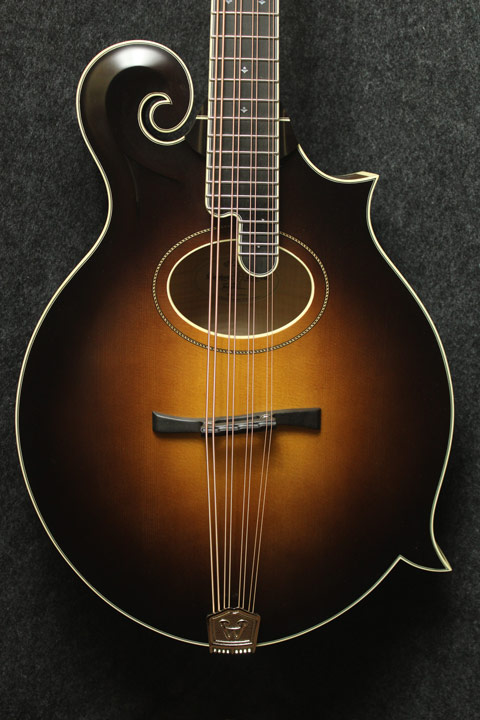
The mandolin family’s largest member is ready to be discovered.
The mandocello is a monster.
The word most commonly used to describe its tone is ‘growl’—a deep, rumbling thunder resulting from the throb of its twinned strings.
Outside of the archaic mandobass, used almost solely in early 20th century mandolin orchestras and featuring single, rather than paired strings, the ‘cello (which itself likely replaced the peculiar, forgotten mandolone) is the largest member of the mandolin family, with its own history stretching back to those same epic community music ensembles.
In the hands of fifths tuning masters like Mike Marshall, whose legendary “Gator Strut” remains a premiere showcase for the instrument, the mandocello is capable of great power, subtlety and articulation—a monster, in all the right ways—yet it remains in many aspects, a mystery, even to longtime mandolinists.
For the uninitiated, what exactly is a mandocello?
The easiest and most obvious answer is that it is the mandolin family equivalent of the cello in the violin family, just as the throaty, ringing, alto-voiced mandola is the fretted, coursed analog of the four-string bowed viola.
As with its symphonic equivalents, the baritone-voiced mandocello is tuned in fifths, a full octave below the viola, ascending CGDA. That low C on a mandocello is a thing of beauty and wonder. It just hums.
There is an ever-expanding solo vocabulary for the regal ‘cello, stretching beyond the expected Bach suites. It’s also finding an increasing role in small ensembles as a rich, bass-like voice for string band and new acoustic music.
Award-winning Canadian mandolinist Andrew Collins has long employed the instrument in his eponymous ‘chambergrass’ trio.
Recently, as an online salve for the pandemic, Collins has been hosting a wide-ranging series dubbed The Isolationist’s Guide to Mandolin, essentially a virtual festival workshop covering topics from jazz to Celtic to backup and beyond.
In July, Collins hosted a special “Big Mando” edition of The Isolationist’s Guide, which briefly addressed the popular octave mandolin, but focused mainly on the mandocello, with contributions from Nashville maestro Tim O’Brien, the always adventurous Kevin Breit and Belgo-Hungarian left-hander Jefferson Louvat.
Each performed solo selections from home studios and joined in conversation with Collins about their individual experiences with the mighty mandocello.
Breit improvised avant jazz, exploring the full range of his instrument while playing up the neck and using firm palm muting to great percussive effect. Collins, unafraid to capo his ‘cello, did, in fact, play some Bach, but also meditated, then romped, through a fascinating medley of Pink Floyd’s “Goodbye Blue Sky” and the Old-Time air “Ship in the Clouds,” exhibiting fantastic speed and control. And O’Brien, who, among other conquests, firmly established the guitar-bodied octave mandolin in the early 90s, played his whimsical tune “Keith in a Palm Tree” on the latter, joined by fellow multi-instrumentalist Jan Fabricius, before stepping over to a recently acquired vintage ‘cello.
Louvat, for his part, talked about, and demonstrated using his mandocello as an accompaniment instrument for his Duo Szabadsag partner, fiddler/vocalist Ariane Cohen-Adad.
He opened the proceedings with a lovely, cleanly-picked and leisurely-paced arrangement of Bela Fleck’s waltz, “For Sascha.”
Certain themes emerged during the discussion among the four players, including the need for a determined physicality to cleanly fret and to drive the heavy gauge strings required to go so low; the need for alternative fingerings to reach certain passages; the nuances of picking along different points on the string length; and the fact that intervals often work as well as, if not better, than full chords in many musical situations.
Breit, who keeps one of his mandocellos strung with octave pairings for a distinctive full range chime, actually performs with and arranges for modern mandolin orchestras, where he fuses his decidedly non-traditional approach with more classic modes of expression.
Collins, though, points out that one trait he loves about the mandocello is its very lack of codification.
“To me,” he shared with his colleagues, “it doesn’t have a real precedent of how to use it, so you kind of have to do a little trailblazing.”
In the Weber universe, you can actually assemble an entire mandolin family, sans mandobass, within the Yellowstone line of dovetailed, gloss nitro-finished, Sitka spruce-topped instruments, starting with an A- or F- style, F-hole or oval-holed mandolin and moving up through F-style, F-hole mandola, octave mandolin and mandocello. All feature ebony fretboards, highly flamed maple backs, ribs and necks and ‘The Weber’ script logos with flowerpot inlays.
The latter, a Burnt Amber Burst F-24-F, features a glorious air chamber within its Florentine points and scroll, a singing 24” scale and a comfortable 1 & 5/8” bone nut.
It is, as you would expect, a monster!
As with all Weber mandolins, the Yellowstone line is proudly sustainable. No clear-cut woods are used in any Weber instrument.
The mandocello is a truly unique beast. Is it time to blaze your own trail?
Learn more about the body shapes. | Learn more about the Yellowstone Mandocello